- Assignment 1: Is pretty much unchanged and will be presented as a series of postcards.
- Assignment 2: Have revisited my tutors feedback, and looked at the images with a view to printing them as I did not prepare full sized prints for Assignment 1. On this basis I've lost the moon-rise images as being a it of a cliche, and moved the poster to the end as a more suitable finish. I have replaced the dence image with an alternative because it simply wasn't sharp enough and added an additional present day reference to Bessemer. My tutor suggested that I might consider an alternative linking image to lead into the community section, but my perception is that, in spite of the somewhat temporary memorials such as the posters and the passing references to Bessemer, the legacy is rapidly being forgotten so I have moved the fence between the "history" and the "present" sections. As well as the required blog post I will be presenting these as A4 prints as well.
- Assignment 3: The pdf book dummy is presented in the pages above. The final presentation will be as a "working journal" of an archaeological expedition to the area at some unspecified time - full details are provided in other posts accessed from the RH menu
- Assignment 4...still to be revised at the time of posting this
- Assignment 5: Will be presented as a magazine in which I try to capture some of the experience of beach-combing. I've received a copy from Blurb and to be honest I'm quite pleased with the way it's turned out.
Sunday, 6 September 2015
Preparing for Assessment

Tuesday, 25 August 2015
Fiona Tan – Baltic Mill, Gateshead
http://www.balticmill.com/whats-on/exhibitions/fiona-tan-depot
Visited this exhibition twice, once on my own and once in the company of some fellow students. The main advertised attraction was her installation DEPOT, which commemorated an event from recent UK history when a large preserved whale was trundled round the country in a very large lorry as a sort of fairground attraction. I had been quite keen to see this as it as advertised as a sort of cabinet of curiosities – but in reality the most curious thing was the fact that anyone bothered to assemble a huge lorry so many floors up.
The cabinets in the back contained some rather delightful glass models of sea anemones, there was a somewhat unlikely narwhal tusk in a case on the wall and a film in what appears to be a trademark Tan style showing a museum collection of preserved aquatic creatures. Overall I found it a bit underwhelming, although I can see that as a modern take on the idea of a cabinet of curiosities it had some traction.
I was rather more interested in the two films showing on the floor below. In one room was Disorient 2009 which according to the catalogue “juxtaposes fantasy and the reality of the trade route between Venice and Asia, with a voiceover comprised solely of evocative quotes from Marco Polo’s 700-year-old book The Travels”. While I didn’t have the time to sit through all of it I found it absolutely fascinating, perhaps because it related so closely to my own ideas in assignment 3 with it’s12th century travelogue contrasting with the images of modern locations on the silk road. It was also twinned with a film which seemed much closer to a cabinet of curiosities – more museum items related to the silk road.
The second film installation Inventory 2012, accompanied by a somewhat eerie soundtrack, was filmed at Sir John Soane’s Museum in London and showed details of his personal collection, which is housed in “one of the most extraordinary public museums in the world”. The sheer quantity of material, packed cheek by jowl in to a relatively small space could not help but generate interesting alignments, and fanciful relationships to keep the imagination running with possible narratives.
I need a closer look at Tan’s work…it seems to have interesting parallels with the work of Mark Dion I blogged in my last post, and both seem to relate to my assignment 5 and to some of the ideas I thinking of taking into my final level (assuming I pass this one). The same holds true for the general philosophy of “cabinets of curiosity” – which is clearly worth some research. I find it more than slightly frustrating that none of this turned up until it was too late to really influence my output on this course, but it does help me contextualise what I’m doing and provide me with some confidence that I’m not completely bonkers.
Sunday, 23 August 2015
Mark Dion and the Arts and Archaeologies of Waste | Material World
Mark Dion and the Arts and Archaeologies of Waste | Material World:
Why have I not studied Mark Dion in more detail before? His work examines the the idas and the institutions which shape our understanding of history, knowledge, and the natural world. A key part of his process...indeed some have suggested that for Dion the process is the art... is to use archaeological methods of collecting, ordering, and exhibiting objects. For example at The Tate he displayed a cabinet of curiosities containing items recovered from an archaeological dig of the Thames foreshore. His works apparently question the distinctions between “objective” (“rational”) scientific methods and “subjective” (“irrational”) influences.
In the article linked in the title the author reflects on the insight that Dion's work offers on the role of waste materials in archaeological practice.
Update: Since the original post I have obtained a copy of Mark Dion: Archaeology which gives much more detailed analysis of his Tate/Thames Dig work, which examines questions such as "Is it art or archaeology?" It is unlikely that I will be able to add a more detailed review here prior to assessment but it is certainly something I intend to carry forward to my Level 3 work.
Reference: Mark Dion, Archaeology: Ed. Coles, A., Black Dog Publishing; London; 2006.
Sunday, 26 July 2015
Rethinking Assignment 5
“If you are inauthentic about the true reasons or motivations behind a piece of your work, then this will be apparent to the viewer.”
With these words fixed firmly in my sights it’s time to think seriously about what to do with this assignment. Why do I take photos of junk on a beach? How does it relate to my previous assignments? How do I convey any of that? How does it relate to the research I’ve been doing on curation and archaeology? How do I present it?
Why do I take photos of junk?
Let’s be honest with myself from the outset – it’s not to offer a critique of documentary photography. My brother once asked if I enjoy taking these images, and the answer is “I do.” I enjoy the sheer randomness, the occasional odd juxtapositions, and if it doesn’t sound too grandiose, I like the idea that the remnants of society are washing up on its edges. It’s quite contemplative – wandering along the tideline looking at clothing; and remnants of furniture; and bottles and tins; and slag and coal left behind by dead industries; and dead livestock. I once even found a message in a bottle which I inexplicably failed to photograph – such was my delight!!

And what do I contemplate…generally the provenance of the objects I’m looking at. Are they local, do they tell me anything about what’s happening locally – or have they travelled some huge distance to wash up on this tiny strip of beach in West Cumbria? This morning I spoke to a woman who claimed she’d once found an arm on a beach – happily I’ve not been that unlucky. The occasional dead sheep or hen is about it for me – but I have found a whole range of things that make me wonder how it got there, and what its story is.
How does it relate to my previous assignments?
In broad terms this relates to some of the stuff I was doing In Landscape 2 – I’m intrigued by the idea that the beach is effectively the defining edge of our living space, analogous to the way Edgelands are the defining edge of urban life. Coming closer to home, I think the links with Assignment 3 are clear enough, in that it makes use of the debris on the beach, and objects in particular, which also ties it to Assignment 4. In 3 I was using the objects to explore an issue – how words and images work together to tell a story. In 4 the objects were themselves the subject of analysis – the challenge for 5 is produce a photo-essay, rather than a story, to capture something of the essence of my thoughts above, and to, perhaps, point up my interests in curation and archaeology.
How does this relate to my research interests?
This seems a good time to quote Berger again “”The photographic narrative form….is not concerned with events as facts – such as is always claimed for photography; it is concerned with their assimilation, their gathering and their transformation into experience.”
So I hopefully have to convey something of the “process” by which I gathered the pictures, and by the editing of the sequence – the curation – try to convey an honest impression of what I see.
How do I convey this? How do I present it?
My tutor suggested a book simply showing the objects, and this has genuine appeal. he suggested calling it something like “The Archaeologist” and this too has appeal – although it’s not actually my idea. I certainly need to capture some of the randomness, and some of the juxtapositions, which means it’s back to the contact sheets to look for new images. I think however, that I’m going to call it “Wonderful things”, after Howard Carter’s reaction to what he could see in Tutankhamen's burial chamber. I’ve no idea what caused that to drop into my head – but it hit me in the shower this morning and seems entirely apt. I will need a few more than the 15 images recommended to do the idea justice, but my tutor has indicated I shouldn’t be hidebound by that and as it is going to be in book form it shouldn’t be an issue.
My initial thoughts are that something as random as a Provoke era Japanese magazine is heading in the right direction although I’m not convinced my design skills are up to it. Kawada’s “The Map” is a less chaotic example and I’m reassured by the seemingly random collections of images that feature in photo books in the BJP. I also think it needs to include an image of me or at least an explicit reference to the manner in which the images are collected, to point up the nature of the activity. I also wonder if a formally bound book is a little too structured, and perhaps hints at a completed work – so i may think about hand stitching my own “magazine” – certainly I think a magazine feel is more appropriate.
References
Berger, J. & Mohr, J., 1982. Another Way of Telling. New York: Pantheon Books.
Farley, P. & Roberts, M., 2011. Edgelands. Kindle ed. London: Jonathan Cape.
Saturday, 25 July 2015
Tullie House – Curator’s Choice
My tutor suggested I blog this as it came up during discussions about the difference between an essay and a narrative. One of the exhibitions currently on display at Tullie House in Carlisle is simply a “curators choice” from their stores. It is, as far as I can tell a random collection of objects which is presumably the individual curators reaction to the materials available for display. There is no clear story but the narrative, assuming there is one, seems to me to be about the breadth and depth of the collection itself. The objects range from squirrel pelts to Lowry paintings and Roman altars to airplane propellers. Some, such as the haaf net on the right, and the Roman altars have clear Cumbrian connections, but others are simply a mystery. I’d love an opportunity to find out why these objects were chosen above any others.
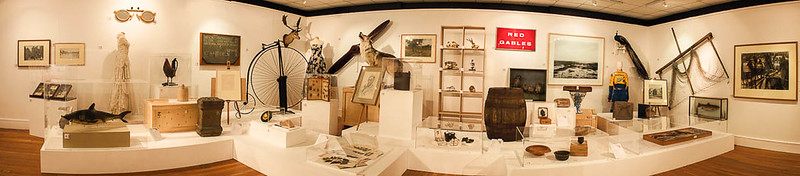
On a related note I visited the Baltic Mill this weekend to see Fiona Tan’s Depot and Disorient. The latter in particular took what felt a familiar route to me. It showed two video loops, on of some of the locations described by Marco Polo in his oriental travels as they currently are, and one showing a storage depot filled with exotic goods, spices and animals associated with the trade routes between the east and Italy at the time of Marco Polo. It is complemented by a voice-over reading excerpts from Polo’s book The Travels. Tan seems to have an interest in collections which I may need to follow up.
Saturday, 18 July 2015
How do you spell ‘pretentious’ ?
In my case it’s spelled “Assignment 5”
It’s fair to say my tutor had a view on this assignment, and he was decent enough to spend considerable time discussing it with me to help me come to an understanding of his concerns. And before we go any further ‘pretentious’ was my final description of it, not his - he never criticised it, simply asked questions about it, and why I’d done it, in the way a good coach should.
So…time to ‘fess up’ to myself.
- I expected to have difficulties with this course, and that became a self-fulfilling prophesy
- I never really understood the difference between documentary and photojournalism, or between the latter and a photo-essay
- In a nutshell I allowed my general dislike of the photo-story and of social documentary to colour my approach to the course.
Being less hard on myself, the course highlighted some things that really do interest me – not least the way in which curation and research allow archaeologists and museum curators (among others) to assemble an understanding of, or provide a reaction to, the material evidence they have available.
The end result of this is that whereas Assignments 2,3, and 4 were reasonably reflections of my interests the same could not be said of Assignment 5.In an attempt to provide a critique of documentary practice as Assignment 5 I basically lost sight of and stopped being honest about the things that interest me, which in this context is curation, archaeology and using my photography to look for meaningful (to me) patterns in the world. The outcome was an over complex idea, which basically made an obvious point – that all curation is subjective - in a rather pretentious way.
To quote my tutor after the discussion “If you are inauthentic about the true reasons or motivations behind a piece of your work, then this will be apparent to the viewer.”
Learning
A re-reading of Hurn/Jay On being a Photographer at my tutors suggestion was very helpful in cementing some of the ideas we discussed.
- Photo-journalism carries an expectation of truth (or at;least some measure of objectivity), while documentary can be a more artistic or analytical response to information or situations.
- There is a difference between a photo-story, which has a linear narrative, and a photo essay which admits complexity, reflection and non-linearity – it does not have to tell a story. Curation can be very similar – there is a curators gallery at Tullie House museum in Carlisle which I visited last week. I’m going to go back because it’s definitely NOT trying to tell a story.
- In Hurn’s words a photo-essay is “…a group of images in which each picture is supporting and strengthening all the others.” It does not mean””…the sequencing of teh pictures can be read like a string of words.” He also notes that all he claims for his work is “..that is what I saw and felt about the subject at the time the pictures were made.”
- All this helps make more sense of many of the photobooks I’ve looked at. I’ve struggled with the idea that I can’t find a story in them, when really I should have been looking for the feeling in them. I first struggled with this in the work of Moriyama, and – not before time – I now understand they’re a reaction not a story. Talk about slow!!!
Next steps
Well the first is to scrap Assignment 5 as it currently is – not the images – just the idea. I had a good discussion with my tutor about how to take this forward and how to capture my interests more honestly. A typology, with its formal ideas of collection and curation is one approach, but I don’t feel that in this context it’s the right answer – I’m not seeking an exhaustive record of everything that washes up – I photograph what feels interesting and relevant on the day. This means I have to capture the feelings (perhaps even pleasure) I get from the strange mixes and juxtapositions presented by the objects I find. I also needs to capture the sense of collecting and curating/studying that I take to my flotsam & jetsam photos. This seems to point to using one of the those photobooks that I’ve previously found rather baffling as a structure.
For the first time in a year I’m actually looking forward to Assignment 5 – it’s a shame I had to complete the course to achieve that.
Tuesday, 14 July 2015
Assignment 3 – Final
As noted for Assignment 2 I tend to keep my response to my tutor report in OneNote, which I’ll submit in printed form at assessment. In summary I need to mute the text a fraction, there were a couple of suggestions about alternatives shots (one in particular was soft) and a strong recommendation to lose the final sunset. Stylistically it was not in keeping with the rest of the work – ditto the front cover. I also need to evidence the development work I put in.
I did consider a couple of alternatives for a front cover shot (see below) but in the end concluded a simple white cover with grey text was more in keeping with the overall design. I’ve tweaked the opening section to be less dogmatic, and hopefully explain a little more clearly what I was trying to get my head around/investigate with this particular work. I’ve also disguised the source of the texts by removing obvious geographic references, so that it comes as more of a surprise to a reader – another suggestions from my tutor.
Alternative cover shots
I like both of these individually and tried them as alternative cover shots. They both seemed attractively enigmatic but ultimately felt they didn’t work – one was too obscure and would have required extensive explanation, the other too colourful compared with the rest of the book. I also considered renaming the book Fe2O3, but in the end felt that using a chapter title from the reference text was more appropriate.


Some theoretical groundwork
The key text that got me thinking about this approach was Berger and Mohr’s “Another Way of Telling” which examines the way pictures work as texts, and why they are sometimes ambiguous – indeed he asserts that they are all ambiguous – I’ve toned down that statement in my intro. The conclusion of this work is a photo-essay of sorts, in which Berger plays with the ambiguities and uncertainties of the image to allow us to build our own narrative around the structure he/Mohr provides.
Short, In Context and Narrative more explicitly examines uses of text alongside and within images to help create narrative. Discussing Simon’s “An American Index of the Hidden and Unfamiliar” she says “The viewer derives understanding from the combination of image and text. Without the accompanying text, the image fails to communicate it’s full meaning and vice versa.”
This lead me to consider how words might lend an entirely different meaning to images, and vice versa, so that by combining two sets of essentially authentic texts I could come up with a reasonably believable work of fiction, by allowing space for an alternative narrative among the ambiguities of both.
Contact sheets
The contact sheets for this work overlap with to some degree those from Assignment 2 available here but also reflect ongoing exploration/collection work on “iron beach” as shown below. In total my image collection in this location covered a period of just over a year and encompassed more than 300 photos.


Subscribe to:
Posts (Atom)