http://www.balticmill.com/whats-on/exhibitions/fiona-tan-depot
Visited this exhibition twice, once on my own and once in the company of some fellow students. The main advertised attraction was her installation DEPOT, which commemorated an event from recent UK history when a large preserved whale was trundled round the country in a very large lorry as a sort of fairground attraction. I had been quite keen to see this as it as advertised as a sort of cabinet of curiosities – but in reality the most curious thing was the fact that anyone bothered to assemble a huge lorry so many floors up.
The cabinets in the back contained some rather delightful glass models of sea anemones, there was a somewhat unlikely narwhal tusk in a case on the wall and a film in what appears to be a trademark Tan style showing a museum collection of preserved aquatic creatures. Overall I found it a bit underwhelming, although I can see that as a modern take on the idea of a cabinet of curiosities it had some traction.
I was rather more interested in the two films showing on the floor below. In one room was Disorient 2009 which according to the catalogue “juxtaposes fantasy and the reality of the trade route between Venice and Asia, with a voiceover comprised solely of evocative quotes from Marco Polo’s 700-year-old book The Travels”. While I didn’t have the time to sit through all of it I found it absolutely fascinating, perhaps because it related so closely to my own ideas in assignment 3 with it’s12th century travelogue contrasting with the images of modern locations on the silk road. It was also twinned with a film which seemed much closer to a cabinet of curiosities – more museum items related to the silk road.
The second film installation Inventory 2012, accompanied by a somewhat eerie soundtrack, was filmed at Sir John Soane’s Museum in London and showed details of his personal collection, which is housed in “one of the most extraordinary public museums in the world”. The sheer quantity of material, packed cheek by jowl in to a relatively small space could not help but generate interesting alignments, and fanciful relationships to keep the imagination running with possible narratives.
I need a closer look at Tan’s work…it seems to have interesting parallels with the work of Mark Dion I blogged in my last post, and both seem to relate to my assignment 5 and to some of the ideas I thinking of taking into my final level (assuming I pass this one). The same holds true for the general philosophy of “cabinets of curiosity” – which is clearly worth some research. I find it more than slightly frustrating that none of this turned up until it was too late to really influence my output on this course, but it does help me contextualise what I’m doing and provide me with some confidence that I’m not completely bonkers.
Showing posts with label Exhibitions. Show all posts
Showing posts with label Exhibitions. Show all posts
Tuesday, 25 August 2015

Saturday, 25 July 2015
Tullie House – Curator’s Choice
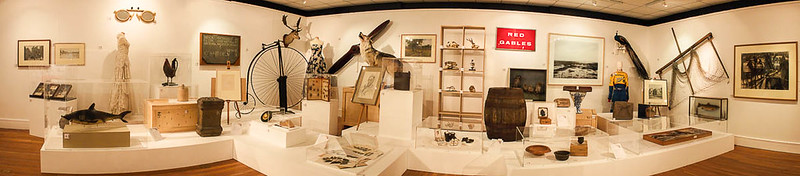
My tutor suggested I blog this as it came up during discussions about the difference between an essay and a narrative. One of the exhibitions currently on display at Tullie House in Carlisle is simply a “curators choice” from their stores. It is, as far as I can tell a random collection of objects which is presumably the individual curators reaction to the materials available for display. There is no clear story but the narrative, assuming there is one, seems to me to be about the breadth and depth of the collection itself. The objects range from squirrel pelts to Lowry paintings and Roman altars to airplane propellers. Some, such as the haaf net on the right, and the Roman altars have clear Cumbrian connections, but others are simply a mystery. I’d love an opportunity to find out why these objects were chosen above any others.
On a related note I visited the Baltic Mill this weekend to see Fiona Tan’s Depot and Disorient. The latter in particular took what felt a familiar route to me. It showed two video loops, on of some of the locations described by Marco Polo in his oriental travels as they currently are, and one showing a storage depot filled with exotic goods, spices and animals associated with the trade routes between the east and Italy at the time of Marco Polo. It is complemented by a voice-over reading excerpts from Polo’s book The Travels. Tan seems to have an interest in collections which I may need to follow up.
Thursday, 18 June 2015
Look 15 – Liverpool
While I enjoy study visits and the interaction with other students there is also a place for simply striking out on your own, and trawling whatever eclectic mix of images takes your fancy at a major photo festival, such as this years “Look 15” in Liverpool.
A bit of web research in advance of the day gave me the following approximate itinerary:
Open Eye Gallery – Open 1 – a variety of artists covering different issues – which seems to be Open Eye’s style
The Bluecoat – Memorandum of Understanding; Tabitha Jussa and Nitrate; Xavier Ribas. The latter in particular appealed for the relatively technical sounding nature of the subject matter
Walker Art Gallery – Only in England; Martin Parr/Tony Ray-Jones – although I’ve looked at both online as part of the coursework, and seen some Parr in a variety of locations, the chance to see a significant body of the work of these two, at the same time was too tempting to miss.
Victoria Gallery – Gypsy Lore; Fred Shaw – this seemed like an opportunity to compare and contrast with Koudelka and Eskildsen, in an extension of a previous exercise.
I augmented this on the day by popping in to see New Landscapes by Gyorgy Kepes at Liverpool John Moores, and some further work by the same artist at Tate Liverpool.
Where to start? My contemporaneous notes are available here: Notes
Open Eye
Helen Marshall’s Project Tobong was an excellent start to the day capturing the tension between old and new in Indonesia, and the impact it is having on a Javanese traditional theatre troupe (and traditional theatre in general). The images are relatively easy to read – the symbolism is quite obvious – but none the worse for that, and the subject matter is sufficiently unfamiliar that there is a bit of anthropological interest thrown in for good measure. I guess a cynic might talk about turning the individuals into spectacle, and there is no obvious hint at what we, or anyone else might do to help, but overall this was an interesting and sometimes amusing insight into the challenges that face traditional artforms the world over.
Elsewhere in Open Eye Louis Quail was showing a selection from his Desk Job set which “explores the phenomenon of globalisation thought the eyes of the office worker”. I quite like the idea that with increasing globalisation our tools and environments are becoming similar, but I can’t help the feeling that this has always been true – an accountants office will have looked pretty much the same anywhere in the world since time immemorial, and I’m pretty sure that in some cases the rather soulless office space was a relatively small proportion of the overall role.
Upstairs Richard Ross was showing a selection of images from his series Juvenile In Justice which documents conditions in young offenders institutions in the US. I have no idea if ours are better – one would have to hope so – but it should be little surprise to anyone if no-one comes out of these places a better person. Distressing
The most interesting work on display for me though was Deborah Kelly’s “The Miracles”. Presented in a series of circular frames of varying sizes and with each individual image lit/propped like a Renaissance painting this was a fascinating series of portraits of families who had children through some kind of assisted reproductive technology. The added depth came from the fact that the subjects were lit and photographed to resemble paintings who’s own histories were questioned/questionable. I’m unconvinced that “heteronormativity” is an actual word, but the idea of interrogating our ancestry in this way seemed to highlight some of the identity issues that the children might face as they grow up. This seemed quite a modernist work in tat you really required quite a lot of previous art knowledge to extract the best from it, so the audio commentary provided by the gallery proved invaluable.
The Bluecoat
The Blue coat was showing three exhibitions which were markedly different in style and content. Tricia Porter’s Liverpool Photo’s 1972-74 was presented as about the break up of tight knit communities but I’m afraid I couldn’t see it. It looked to be fairly standard mid-70s social documentary, and to my untutored eye could have been just about any city in the UK at the time.
Upstairs Tabitha Jussa was showing Memorandum of Understanding – a study of urban development in Liverpool and its “twin” Shanghai. The images were very large panoramas, which is a style I enjoy, and while I found them enjoyable top look at I’m again unsure what the “take-away” was. In particular I’m still not really clear why the photos of Shanghai featured people, while the Liverpool equivalents did not. Maybe it’s no more than a genuine reflection of what her working practice turns up, or a result of the differing impacts of a city in which live and one where you’re a visitor. Sadly the images are not yet on Jussa’s website so I have no real opportunity to see them again and consider them further.
The other major exhibition showing here was Nitrate by Xavier Ribas. This work examines the history of the extraction of nitrates for use in fertilisers and explosives from the Atacama Desert since the late 19th Century. It encompasses archival images from official and un-official sources, photos and moving images from Ribas himself and a range of texts from diverse historical sources. During his work Ribas uncovered previously unknown material from a British astronomical expedition to the Atacama, which is also incorporated. Overall I was captivated. The work is more like a piece of social anthropology than a simple documentary project and I can’t help wondering if a similar work about the West Cumbrian iron/steel industry might not make a great project for Level 3.
The Walker Art Gallery
The Walker was showing a compilation of Tony Ray-Jones and Martin Parr images showing the lasting influence of Ray-Jones on British photography – perhaps even on our overall understanding of Britishness. The exhibition also featured a set of R-J images curated by Parr, which if nothing else seemed to underline the importance of curation in providing a narrative, as I felt the Parr selection lacked the humour of the R-J curated images – perhaps unsurprisingly they felt more like Parr’s rather cool, neutral, appraisial of British quirkiness.
Amazingly for such a major exhibition there appeared to be no catalog!!
Victoria Gallery
Fred Shaw apparently enjoyed the company of “gypsies” and, as a result of joining his midwife mother on visits to their homes, seemed to have a particular affinity for them. The result is a large collection of portraits taken over his lifetime. They have a very different feel from Koudelka – being closer to Sander’s style, so that e get very little sense of their lives or preoccupations. We are, for example, presented with an image of “Sam Smith (The Fighting Gypsy)” – but from the photo he could just as easily have been The Horse Whispering Gypsy – we get no hint of how his nickname was arrived at. Maybe that’s the point, but without this kind of characterisation we are simply left with a random collection of country folk from the same era, with no sense of gypsy culture floating to the surface. Intriguing but not quite what I expected.
Liverpool John Moores and Tate Liverpool
Gyorgy Kepes was a designer and visual theorist who, according to the notes, was interested in finding channels of communication which interconnect various disciplines. In particular, if these exhibitions are anything to go by, between art and science, and between nature and the man-made. His images seem to follow the same path surrealist path as Man Ray, and he frequently combines hard edged man-made objects with softer organic materials in abstract or near abstract imagery. I found the John Moores exhibit rather more intriguing. The manner in which the pictures were displayed on suspended panels seems rather commonplace today, but appears to have been revolutionary at the time, allowing him to create constantly changing juxtapositions of images as you move around the display. It is easy to take this kind of ting for granted, and useful to be reminded that someone actually had top invent the concept of displaying art on suspended panels in this way. Along with Nitrate this was the stand-out exhibition of the day for me.
Saturday, 11 April 2015
Study Visit: Metamorphosis of Japan after the war – Open Eye Gallery Liverpool: 21 March 2015

Given the degree of change that Japan saw in this period 100 photos and 11 photographers was always going to be rather “broad brush” but there were nonetheless some fascinating contrasts and a real sense of change was developed through the exhibition.
The exhibition was divided into 3 broad sections – the first covering the immediate aftermath of the war, the second the period of social modernisation and both characterised by photo-realism – fairly traditional documentary photography. The final section, in which a new national pride and identity emerges, shows Japanese photography emerging from its photographic realism phase into a more subjective medium.
The first section started, perhaps inevitably, with Hamaya’s “The Sun on the Day of Defeat” and has a whole selection of shots showing the desperate straits city dwellers in particular found themselves in in the years after the war. It was during this period that the influence of Ken Domon and his strict photo-realism really started to bite – such that the primary focus of Japanese photography throughout much of the decade after the war was straight photography. Oddly this also produced some startlingly enjoyable images such as Kimura’s beautiful portrait of a Young Woman in traditional dress and the almost impossibly cute “Dressed to go shopping” by Tanuma. Better versions of these can be found on the links. Kawada’s “The Map” is a subjective and powerful view of the scars left by the war, which, as the taped commentary available on the Open Eye website implies is photographically closer to the era of the third section, but content wise clearly belongs to a nation coming to terms with a major war.
The second section has more transitional imagery reflecting Japan’s search for its identity – including more work by Hamaya – one of my favourite photographers. Hamaya was the first Japanese photographer to join Magnum and spent much time photographing areas of Japan where tradition hung on. The classic example is probably Yukiguni which was not represented in this exhibition but many will have seen his “Woman planting rice”. Much of his work is more personal than contemporary social documentary work. He also photographed the student riots of the period – represented here by a “during and after” pair of shots showing something of the passions released during this period.
The final section has clearly moved away from Domon’s straight photography. Hosoe’s Barakei draws on traditional Japanese drama to produce works with a theatricality which some have argued was unknown to the west – while Tomatsu’s Hiroshima work is also well removed from the realist tradition relying on the symbolism of objects to create its narrative.
I don’t think it’s possible to leave this exhibition without a sense of the huge changes Japan has undergone, and the way that photography has adopted – perhaps even helped shape – the new national identity that resulted. And yet – almost like parentheses around the period - Hamaya’s opening shot reminds me of some of Moriyama’s Provoke work. Oddly, it was a pointer to the changes to come.
Friday, 4 July 2014
Beyond the Border: New Contemporary Photography from Scotland
Attended this exhibition, complete with presentations from the photographers as part of a study visit - as always great to meet fellow students.
The exhibition featured the work of four photographers who form the Document Scotland collective. Without going in to too much detail - their website features a very good selection of their material - it's worth noting that this is a much gentler form of documentary than much we are directed to by the student notes. It is also much more personal a collection of investigations, into the Antonine Wall, the differences a short border crossing can make to everyday life, the lives of women in the countryside and what it means to adopt Scottish heritage in the USA.
The over-riding impression is of a bodies of work seeking to re-make, or perhaps strengthen their links with their home country at a key moment in its history, and made all the better for resisting the urge to engage in nationalistic campaigning of either persuasion.
The exhibition featured the work of four photographers who form the Document Scotland collective. Without going in to too much detail - their website features a very good selection of their material - it's worth noting that this is a much gentler form of documentary than much we are directed to by the student notes. It is also much more personal a collection of investigations, into the Antonine Wall, the differences a short border crossing can make to everyday life, the lives of women in the countryside and what it means to adopt Scottish heritage in the USA.
The over-riding impression is of a bodies of work seeking to re-make, or perhaps strengthen their links with their home country at a key moment in its history, and made all the better for resisting the urge to engage in nationalistic campaigning of either persuasion.
Subscribe to:
Posts (Atom)