- Assignment 1: Is pretty much unchanged and will be presented as a series of postcards.
- Assignment 2: Have revisited my tutors feedback, and looked at the images with a view to printing them as I did not prepare full sized prints for Assignment 1. On this basis I've lost the moon-rise images as being a it of a cliche, and moved the poster to the end as a more suitable finish. I have replaced the dence image with an alternative because it simply wasn't sharp enough and added an additional present day reference to Bessemer. My tutor suggested that I might consider an alternative linking image to lead into the community section, but my perception is that, in spite of the somewhat temporary memorials such as the posters and the passing references to Bessemer, the legacy is rapidly being forgotten so I have moved the fence between the "history" and the "present" sections. As well as the required blog post I will be presenting these as A4 prints as well.
- Assignment 3: The pdf book dummy is presented in the pages above. The final presentation will be as a "working journal" of an archaeological expedition to the area at some unspecified time - full details are provided in other posts accessed from the RH menu
- Assignment 4...still to be revised at the time of posting this
- Assignment 5: Will be presented as a magazine in which I try to capture some of the experience of beach-combing. I've received a copy from Blurb and to be honest I'm quite pleased with the way it's turned out.
Showing posts with label Assignment 4. Show all posts
Showing posts with label Assignment 4. Show all posts
Sunday, 6 September 2015
Preparing for Assessment

Saturday, 7 February 2015
Possessed
One feature of having a real block is that all sorts of things you should have done get skipped. I’ve got my work cut out now to put that right, but that’s my own fault. The beginning of November saw the 3rd Carlisle photo festival (which I’ll write up elsewhere), but one of the exhibits which really grabbed me – and has grown on me ever since was Possessed by Sarah Faraday and Yujiang Wang.
The Possessed project – which can be found at www.possessed.org.uk – “operates by participants giving up objects of personal importance…” In return the artists take two photos – one for the exhibition and one for the participating donor. According to their statement the process of documenting the objects serves a dual purpose – it is part of the act of letting go and it serves as a reflection on the role of the image as an archival document.
On the face of it I think it also asks questions about how we see photos of objects - do we see them as photos or do we see them as the objects themselves? I seem to recall Barthes (or was it Sontag?) expounding on something similar with pictures of deceased relatives standing in for the person themselves in family conversations. Few of the participants feelings on this issue are actually recorded – Leila’s jeans is an exception, where it is clear that the image hovers on the boundary of actually replacing the jeans in terms of the emotional attachment felt. Travel memories falls into a similar category.
A more tricky question – asked by the artists – is “Can the camera capture anything of the emotion invested in an object?” On the face of these images I feel the answer is probably not. This is not a failing of the artist – simply a reflection that deadpan photography is not ideally suited to this task. yes – we can wonder what caused all the dents and dings in the spanner, why and how a pair of climbing shoes got so battered, and we can surmise some things about the owners life on the basis – but I think it’s stretching it to say that they can illustrate the emotional links in isolation without some supporting contextual material – as in this example where there is a hint of something more personal. Berger makes much the same point in “Another way of telling”.
Other material
Sarah Faraday’s website: http://www.sarahfaraday.co.uk/
Yujiang Wang’s website:http://www.xaphire.de/
Sunday, 1 February 2015
Semiotics: Blood swept land and seas of red – the construction of meaning
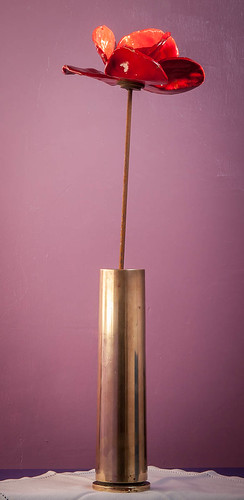
I’ve recently taken delivery of one of the ceramic poppies from the Cummins/Piper artwork “Blood swept lands and seas of red” which was on display at the Tower of London from July until November 2014. I’m not quite sure about the overall artwork, which strikes me as a little cliched – although I don’t buy the criticism relating to it only representing the 888,246 British WWI dead.
However, the individual poppies struck me as what Sherry Turkle would call evocative objects (Turkle 2007) – provocations to thought, which is why I successfully applied to buy one. There is little tradition of military service in my family beyond that required by National Service – in as much as I have any details I know one of my grandfathers was a PoW in WWI and my father served in naval dockyards but no more. So how does this poppy make me think – and how does it help me relate to a field of activity of which I have exactly zero experience?
In examining this I’m going to use a framework based on semiotics, and used by Susan Pearce in an essay examining how we assign personal meaning to a jacket worn at the Battle of Waterloo (in Pearce, 1994). The poppy and the shell case are a text which we can analyse to understand how meaning is acquired. The photograph here is indexical – essentially proof that these objects have existed in this arrangement.
So – we start with the facts. The poppy is ceramic, and as noted above was one of almost 900,000 prepared and displayed to mark the 100th anniversary of the start of WW1. It is unique – in as much as it is hand-made and so features inevitable variations in finish. The stem is slightly rusty mild steel wire.
The shell case was purchased in a local antique shop for the specific purpose of mounting the poppy. According to the details on the bottom it was a 40mm shell, and the case was cordite filled at Birtley,Tyne and Wear, in 1943. It had no prior sentimental value for me.
Following the general method of Pearce (Pearce 1994) it’s worth noting the general background against which the articles were produced. The shell is perhaps easiest – it is, in all likelihood a shell case that was used in a Bofors anti-aircraft gun. It was produced in wartime and its sole purpose was to kill. It is the product of a military industrial culture that was busy defending itself from another military industrial culture and the people that prepared and used it understood this at some personal level.
The poppy on the other hand was prepared in an art studio – of sorts – by hand, for the purposes of an art exhibition. Views on warfare at the time of production were very much more mixed. The 100th anniversary of WW1 is also the 100th anniversary of our ability to mechanise slaughter to an appalling degree – the number of poppies reflects that. It was held at a time when the last survivors of the war itself were passing away and into history, and it also came as British involvement in the prolonged wars in Afghanistan and Iraq was drawing to close, an event marked by an apparent desire to recognise the sacrifices of those who died while not condoning the actions of the governments that involved us in the war.
This is part of what Sassure referred to as the langue (cited in Chandler,2004) – the cultural reference frame in which the text resides. The parole – the specific set of rules used to interpret this text – include the place of the poppy in our culture, the role of industrial markings in identifying items, the way we culturally value things and at a more personal level, my ability to imagine a history for one of the objects on the basis of information found on the internet.
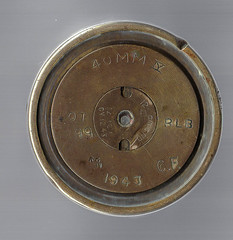
The costs of the shell case and the poppy were not dissimilar, but are arrived at and justified in different ways. The shell case as a military souvenir, the poppy as a unique work of art (or at least a part of one). As Pearce (in Pearce,1997) notes in a different essay in the collection the uniqueness of the hand-made object has acquired a particular poignancy since the onset of mechanical reproduction. Set against that, although the shell case is clearly mass produced the markings on the underside clearly identify it as a unique object, and it bears a number of dents which presumably arose while it was being fired and ejected and cleared away from the gun.
The shell case acts on two levels – it is indexical in as much as I believe it to have been fired in anger (or at the very least in practice anger). It provides a direct link to an act of war and everything that implies and to the military machine that produced it. It is also symbolic – of warfare in general and the live/die circumstances that people often found themselves in.
The poppy acts on three levels – it is indexical of the exhibition, and the production methods that produced it. It does not index warfare. That link is symbolic – a result of a culture that has chosen to associate poppies with loss, sacrifice and the military dead. It is also iconic in the true meaning of the word, as it stands in for both the exhibition as a whole and the wild poppies that grew in Flanders during WW1.
If we take each on their own the meaning is limited – the shell case perhaps make us wonder at the efficiency with which we produce weapons, and unless we are directly affected the poppy induces a general sense of sentimental reverence.
Because of the contrasting nature and meaning of the two items, the combination as portrayed in the image can be read as offering a comment on the way in which the industrial war machine snuffs out the individuality of people. In doing so it turns them from items of general interest into a genuinely evocative object.
References
Chandler, D. (2004). Semiotics: The Basics. New York: Taylor and Francis e-Library.
Pearce, S. M. (1994). Interpreting Objects and Collections (e-Library ed.). New York: Routledge.
Turkle, S. (2007). Evocative objects: things we think with (Kindle ed.). Cambridge, Mass.: MIT.
Thursday, 22 January 2015
Duck racing
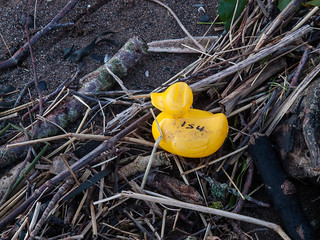
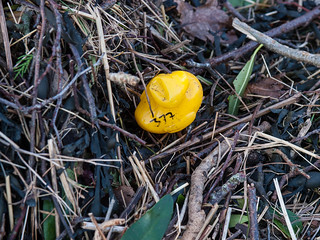
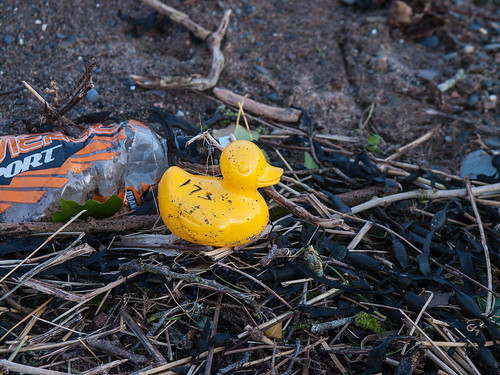
Early on in our time in Cumbria, Marion and I attended a local charity duck race. As i recall the company I worked for had sponsored the prize so I was there to hand it over. Anyway – it was a thoroughly fun afternoon cheering on the plastic ducks as the drifted down the river. Despite the best efforts of the organisers I’m sure it is not possible to catch all of them – and these shots show that someone, somewhere had the same problem. Just how long these little guys have been drifting offshore is anyone’s guess.
Subscribe to:
Posts (Atom)